Opinion
Opinion: A name struck off on paper is a citizen struck off in fact
The voter roll is the people's title deed to the republic, not the government's guest list. Deleting names without notice or hearing turns revision into selection, this opinion argues.

There is a quiet way to kill a vote. You do not ban the election, burn the ballot box or beat the voter. You strike the name off a list in an office the voter will never enter, under a rule the voter cannot afford to satisfy, and you call the striking cleanliness.
That is the fight now on India's streets. The Special Intensive Revision of electoral rolls began in Bihar and has spread to most of the country. The Election Commission says it is removing duplicates, the dead and the ineligible. Nobody honest defends a dirty roll. But a revision is judged not by its press note. It is judged by who disappears. When the burden of proving citizenship falls, document by document, on the migrant who rents one room, the woman whose papers carry a father's name and a husband's address, the worker whose whole archive fits in a plastic folder, deletion is not an accident of the process. It is the process, working exactly on those least able to appeal it. Opposition parties cite the Commission's own figures to warn that rolls could shrink by as much as 30 per cent in some regions. Even a fraction of that, wrongly taken, is not housekeeping. It is disenfranchisement with a file number.
The Dravidian movement was built on the opposite arithmetic. Periyar's demand for self-respect began with the proposition that no human being needs a priest, a caste elder or a clerk to certify their worth. Anna carried that proposition to its democratic conclusion: the vote of the poorest citizen weighs exactly what the vote of the richest weighs, and the state's first duty is to keep both names on the list, not to audition them. Kalaignar's welfare state, whatever its quarrels, assumed the citizen as a rights-holder who summons the government, not a supplicant who must re-apply for existence every few years. A voter roll, in that tradition, is not the government's guest list. It is the people's title deed to the republic. You do not prune a title deed in silence.
Three duties follow, and none of them is radical. First, no deletion without notice, hearing and a published, booth-level list of every name removed and why, in a form a village can read, not a portal a village must beg. Second, the burden of proof belongs to the state that alleges ineligibility, not to the citizen who has voted, paid and lived. Third, when the Supreme Court asks for records, as it did this week, the Commission should arrive with files, not adjectives. An umpire who will not show the scorebook has already picked a side.
And Tamil Nadu should hear its own warning in Delhi's barricades. When opposition MPs from across India must sit on Parliament Street to be heard by their own election commission, a state government that prides itself on administrative flair has a duty larger than silence: to audit its own rolls in public, booth by booth, before Delhi's method becomes Chennai's habit. The TVK government came to power promising a purer politics. Purity that begins by thinning the electorate is not purity. It is selection. The Justice will keep asking the only question that matters: show us the names you removed, and show us why. A democracy that cannot answer in daylight does not deserve the dark's benefit of the doubt.
Sources
Share this story
Related articles
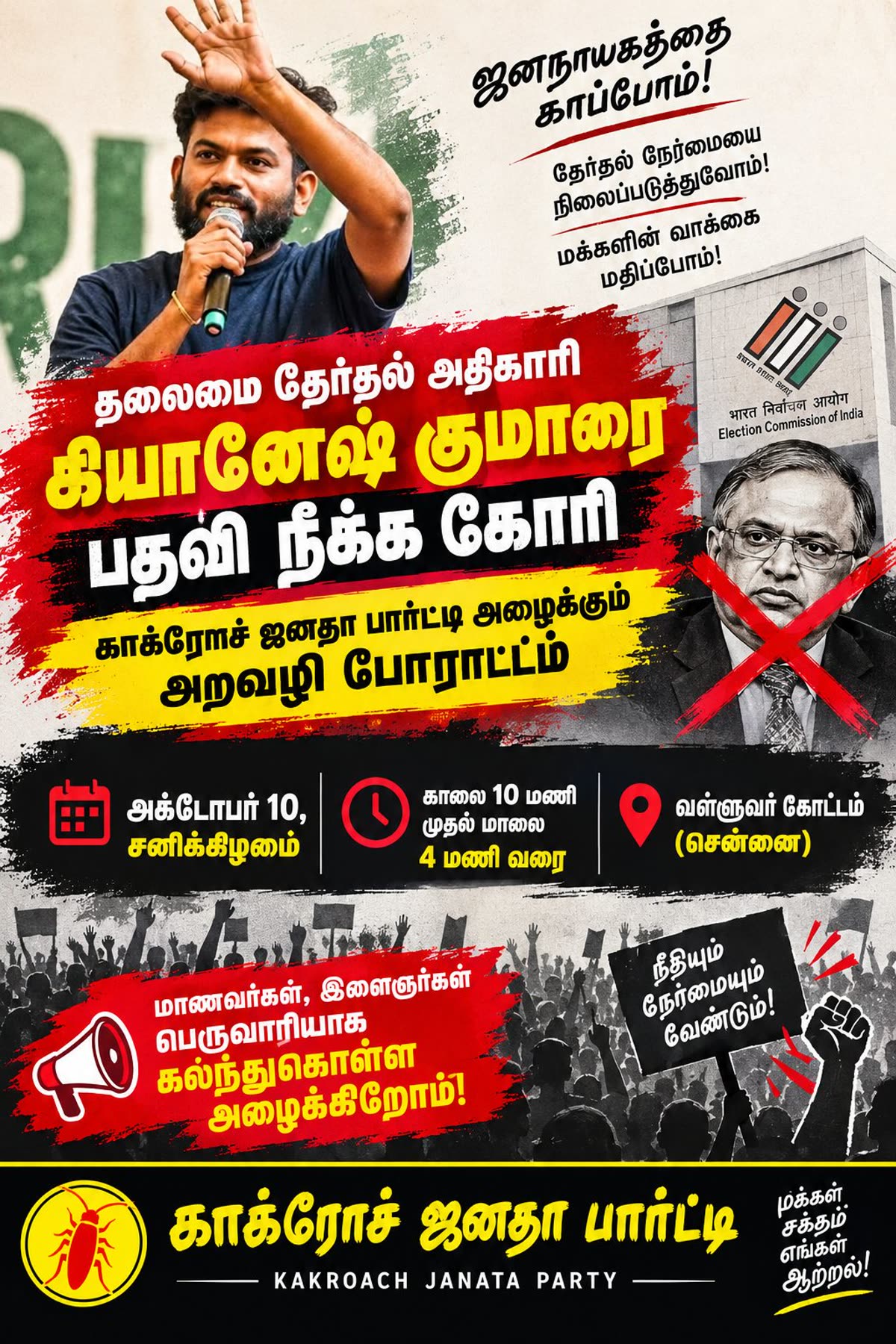
Remove Gyanesh Kumar: Cockroach Janata Party Summons Chennai to Valluvar Kottam on October 10
The Tamil Nadu unit of the Cockroach Janata Party has called a day-long peaceful protest at Valluvar Kottam on October 10, demanding the removal of Chief Election Commissioner Gyanesh Kumar over the mass deletion of voters from the electoral rolls.
· 2 min read
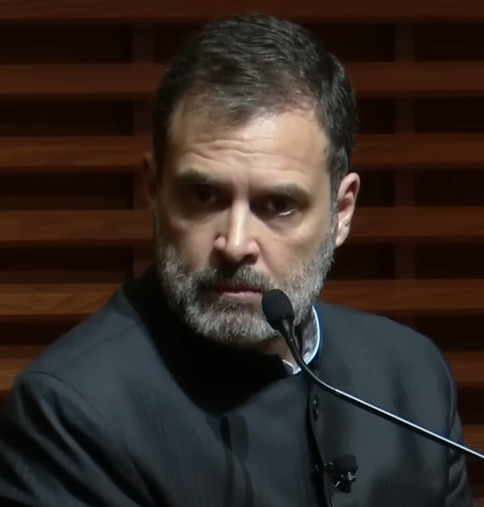
'He should definitely be removed': DMK defends Rahul Gandhi's CEC protest a day after questioning his silence
A day after a DMK spokesperson questioned Rahul Gandhi's silence on Tamil Nadu voter deletions, the party defended his protest against the Chief Election Commissioner and accused the Centre of blocking citizens from fighting for fair elections.
· 2 min read
Opinion: An airworthiness certificate must never look like it is for sale
A Chennai bribery arrest inside aviation's safety regulator is not only a crime story. It is a test of whether public systems protect ordinary people who cannot inspect the machine they are asked to trust.
· 2 min read
Opinion: Who eats, who waits, and who is only heard after the cameras arrive
A tonne of ration rice seized in Ranipet and an 87-year-old carried out of her Madrid home tell the same story: systems that count stock and title first, and people only when forced. Periyar's question still stands: who eats, who waits, and who is heard too late?
· 2 min read